Society of Motor Manufacturers and Traders (SMMT)—Written evidence
Introduction
- The Society of Motor Manufacturers and Traders (SMMT) is one of the largest and most influential trade associations in the UK. It supports the interests of the UK automotive industry at home and abroad, promoting a united position to government, stakeholders and the media. The automotive industry is a vital part of the UK economy accounting for more than £64 billion turnover and £12 billion value added. With more than 160,000 people employed directly in manufacturing and in excess of 770,000 across the wider automotive industry, it accounts for 10% of total UK export of goods and invests £1.9 billion each year in automotive R&D. More than 30 manufacturers build in excess of 70 models of vehicle in the UK supported by around 2,500 component providers and some of the world's most skilled engineers.
- SMMT welcomes the opportunity to provide written input to the House of Lords Economic Affairs Committee on connected and autonomous vehicles in relation to its inquiry on the Economic Case for High Speed 2. SMMT is not in a position to comment on the specifics of High Speed 2 but has outlined in this paper the opportunities that connected and autonomous vehicles present to the UK.
Summary
- SMMT would like to highlight the following points in summary:
- The move to connected and autonomous vehicles represents a significant economic opportunity for the UK which will require collaboration between government, the automotive industry and other technology sectors.
- For the UK to exploit this opportunity, it is important for government to provide a supportive regulatory environment for increasingly connected vehicles and funding for research and development to encourage greater testing and trialling of this technology in the UK.
- It will be important for government and industry to work together in overcoming uncertainties of new technology and removing barriers to the deployment and uptake of connected and autonomous vehicles. It will also be important for the automotive industry to work in close collaboration with adjacent industries such as technology, telecoms, creative and digital, consumer electronics, business services, legal and insurance to develop technologies and applications that are fundamental to connected and autonomous vehicles.
- The increased focus on data will present issues as well as business opportunities. This will be an important area of focus as connected and autonomous vehicles become a commercial reality.
- It is too early to determine the impact of autonomous and connected vehicles on the road network or on wider road transport, however key benefits around improving traffic flow and journey times will lead to reduced emissions and wider economic benefits.
Background
- Intelligent mobility, connected vehicles and autonomous vehicles are terms that are often used interchangeably to describe the increasing level of connectivity and autonomy within vehicles. Each term has a distinctive and different description that is important to understand when looking at the future technological trends in vehicles.
- Intelligent mobility is the overarching term describing the interlinking of technologies that will deliver integrated transport systems that “increase mobility, improve safety, and enhance user benefits whilst simultaneously reducing pollution, consumption, and congestion”[1].
- The Automotive Council has produced a roadmap (below) on the timeline for intelligent mobility with targets for the delivery of certain technologies.

(http://www.automotivecouncil.co.uk/wp-content/uploads/2013/09/Intelligent-mobility.jpg)
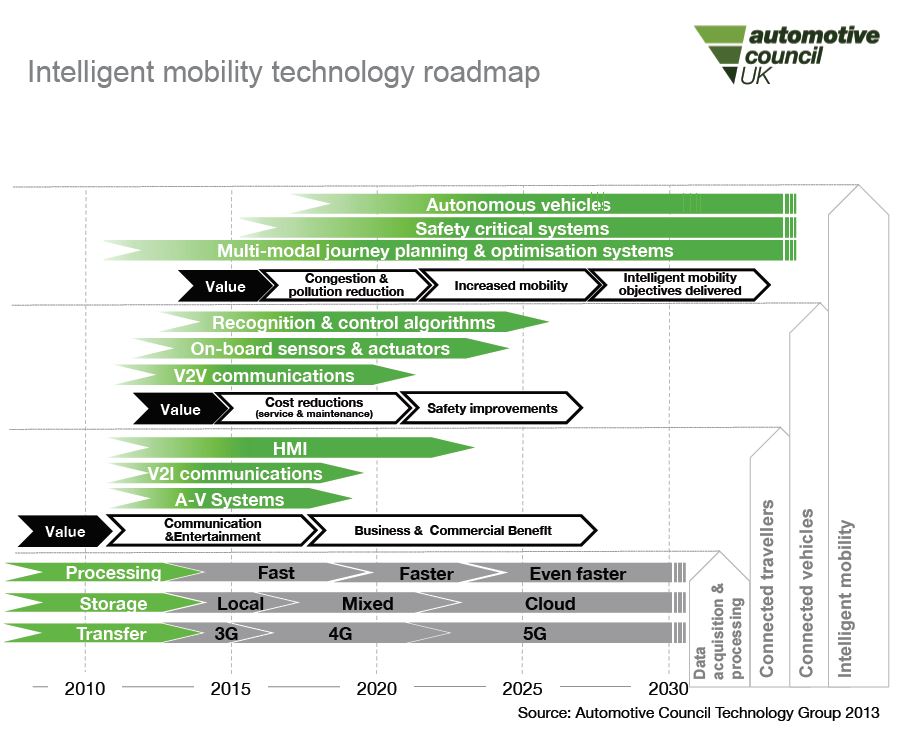
- The roadmap demonstrates the timeline for introduction of various technologies within intelligent mobility, highlighting the value to consumers, business and society each evolution of technology will bring. Although targets such as 2020 to 2030 are provided regarding the mainstream introduction of autonomous vehicles autonomous features are already a readily available aspect of many new vehicles on the UK’s roads today.
- Connected and autonomous vehicles are two terms that describe the growing introduction of technology into vehicles that enables them to become more connected with their surroundings and benefits to drivers from increased levels of autonomy. Although autonomous vehicle technology will aid the advent of connected vehicles, the two terms must be recognised as separate features.
- Connected vehicles refer to the ability of vehicles to communicate with infrastructure and other vehicles as part of the wider trend to greater connectivity of technology and the ‘internet of things’. Vehicle-to-vehicle and vehicle-to-infrastructure connectivity could fundamentally change the way in which roads are used with potential improvements in emissions, safety and congestion. The connected nature of road transport presents opportunities for vehicles to be able to respond to changing road conditions and connect with other modes of transport.
- Autonomous vehicles refer to the ability of vehicles to take control of various aspects of driving. Connected vehicles and autonomous driving elements are already on our roads and feature in the vehicles we drive today. There are various stages and levels of autonomy which will proliferate vehicle development and deployment over a number of years. A fully autonomous vehicle can be characterised as a driverless car, however there are various stages of autonomy that have been identified which demonstrate varying technological capabilities:
0 = No autonomous features
1 = Features such as automatic braking sensors are fitted on vehicle
2 = Features such as car parking assist where driver relinquishes control of vehicle
3 = Features such as smart, adaptive cruise control allow for ‘platooning’ of vehicles
4/5 = Vehicle is highly or fully autonomous

- As described previously, levels four and five of high and full automation are some way from being mainstream on the UK’s roads, however technologies enabling levels one and two and to some extent level three are already being utilised on vehicles today. This demonstrates that the move to greater autonomy is already happening and that ‘driverless’ cars are part of this transition of gradual introduction of technology.
- According to a study by management consultants Oliver Wyman, 80% of all autos sold in 2016 will be connected. This figure shows a projected annual growth rate of over 36%, from 45 million autos in 2011 to approximately 210 million by 2016.
The UK industrial opportunity
- Opportunities from connectivity and autonomous vehicles present the ability to harness new investment into the UK automotive industry, as well as offering benefits in terms of road safety, mitigating congestion and reducing emissions. The Automotive Council has identified intelligent mobility as one the five ‘sticky’ or priority technologies crucial for the UK’s industrial strategy.
- The development of intelligent mobility technologies also needs to be supported through intensified collaboration between automotive and relevant sectors and specialisms such as electronics, robotics, satellite and data/communication technologies and transport planners. The different ‘clock-speeds’ of the contributing sectors and lack of common development process are key challenges that need addressing. Below are the average development cycles of new technologies and policies from various sectors:
Automotive = 3 - 7 year cycle
Digital = 1 - 3 year cycle
Transport = 4 - 20 year cycle
City = 5 - 50 year cycle
- To bring interested organisations together, SMMT is hosting an event on 26 March which looks to initiate greater collaboration between government and interested sectors on connectivity. It will be important to engage with those sectors not traditionally involved with the automotive industry to ensure the UK can deliver on becoming a centre of excellence on connected and autonomous vehicles.
- SMMT is currently undertaking a study into the economic impact of connected and autonomous vehicles in the UK to assess the industrial opportunity and would be happy to brief the Committee on the findings when complete.
Government’s role
- The development, trialling and deployment of connected and autonomous vehicle technologies will raise new regulatory and legal questions around use on public roads, shared data, communication and insurance issues. Government assistance and intervention, such as in the LUTZ (Low-carbon Urban Transport Zone) Pathfinder project in Milton Keynes, the £19 million driverless car fund for cities and the recent DfT regulatory review for the testing of autonomous vehicles are welcome.
- SMMT highlighted connected and autonomous vehicles as a priority area in its representation to HM Treasury ahead of Budget 2015. SMMT will work closely with the Department for Transport in the development of a Code of Practice to establish a supportive framework for further trialling and deployment of technology.
- Greater investment and innovation support is needed in order for the UK to maximise its potential as a leading location for connectivity. Large scale R&D funding is required to realise the significant opportunities both connectivity and intelligent mobility present the UK economy. SMMT supports the introduction of a specific R&D fund for connected and autonomous vehicles to create a world-leading offer to innovative companies wanting to invest in intelligent mobility, providing the necessary communications and infrastructure to initiate co-investment from industry.
Policy perspective
- The UK is already in a positive position in relation to the trialling of autonomous vehicles and the regulatory framework to allow autonomous vehicles to operate on public roads. In partnership with Innovate UK, £19 million funding was assigned by the Chancellor at the 2014 Autumn Statement to facilitate trials in Greenwich, Bristol and a Milton Keynes-Coventry joint project with an initial time-frame of 18-36 months. As trials have begun to take place, further commitments from government have been made with the “Pathway to Driverless Vehicles” regulatory review published by the Department for Transport on 11 February 2015. This document builds on the announcements already made by central Government on connected and autonomous vehicles and will provide the regulatory certainty for trials to be carried out. This review also lays the foundations for enabling wider use of autonomous vehicles on UK roads.
- With regards to potential barriers to progress, the following areas have been identified:
- As with the introduction of new technology, initial costs are likely to be high, reflecting the costs of research and development and introduction of new hardware and software requirements such as new sensors, communication and guidance function technology, and software.
- Licensing has been identified as an area where further consideration needs to be given. Without a consistent licensing framework manufacturers may be left with regulatory uncertainty and unnecessary overlap
- Liability issues around autonomous vehicles need to be considered and clearly defined in the event of an accident. This is particularly key in relation to legal certainty as well as insurance.
- With the introduction of new technology, particularly in the case of connected and autonomous vehicles where high levels of intelligence and communications are present, security will be a key consideration in order to protect systems and vehicles from hackers, terrorists or hostile nations
- There are research gaps that need to be addressed due to the inherent uncertain nature of new technology in new contexts. Autonomous vehicles are not yet present in our traffic streams therefore research, trialling and testing will be critical to ensuring this technology can operate on public roads and delivers the benefits outlined previously.
- Issues around data ownership and privacy are of crucial importance to the development and deployment of connected and autonomous vehicles. Questions around who should own or control data will need to be addressed, but this also presents potential new business opportunities as described below.
- The development of connected and autonomous vehicles technology requires cross-industry collaboration. Though led by the automotive industry, without close collaboration with adjacent industries such as technology, telecoms, creative and digital, business services, legal and insurance, the development of these vehicles will be hampered, and their diffusion and adoption delayed, The practicalities of bringing companies from disparate disciplines and industries together in secure networks are arguably challenging.
Importance of data
- Four key attributes of big data include volume (quantity), velocity (speed of communication), variety (different formats and sources), and value (converted to meaningful insights). Connected vehicles could provide a stream of data on vehicle movements, condition, wear and tear of parts, and ambient conditions. The challenge will be to extract meaning from this mass of mixed data, which will need to be transmitted, analysed and they redistributed to all the relevant subjects – all at high speed.
- Benefits of big data in the connected vehicle context could include:
- Improved car development
- Enhanced planning of service and repair intervals due to early fault recognition
- Increased customer satisfaction and retention
- Improved response time to emergency, accidents and breakdowns
- Better optimisation of traffic flows through vehicle routing and infrastructure management
- Improved optimisation of energy distribution for connected electric vehicles through smart grids
- New services, from retail and FMCG to insurance and healthcare, are spawned through better understanding of drivers/customers’ preferences, needs and behaviour
- At present, the majority of connected car data is used internally for diagnostics, location, speed, and vehicle status. By 2020, the IHS Automotive study expects four core categories of data to be most important to automakers, suppliers, third parties and end-users – diagnostics, location, user experience/features, and adaptive driver assistance systems/autonomy data.
- The rate at which data is flowing from the connected car landscape is also growing dramatically. The study by IHS Automotive, Emerging technologies: Big Data in the Connected Car, says that about 30 terabytes of data would be collected each day from the 152 million connected cars on the road in 2020, or about 350 megabytes per second, compared to about 15 megabytes per second in 2013.
- The importance of data and its communication reiterates the need for various industries and sectors to collaborate to realise the potential economic benefits of this new technology.
Impact on transport
- It is too early to be able to predict the impact of increased connectivity and the introduction of autonomous vehicles on road or public transport, however changing driving trends and models of vehicle ownership can point to the future direction of mobility. Short urban and suburban journeys have already seen the introduction of car sharing clubs and short-term renting arrangements. The introduction of the concept of purchasing mobility rather than the traditional concept of purchasing vehicles demonstrates the growing interconnectedness of transport, reflecting the needs of travellers and drivers. Whether these trends will reduce the number of vehicles within the parc (vehicles on the road) going forward is unknown although it is clear that opportunities will be created by the introduction of connected vehicles across all sectors.
- The Roads Investment Strategy announced in December 2014 has included elements relating to the introduction of autonomous vehicles bringing together ‘connected’ infrastructure and intelligent mobility on the Strategic Road Network (SRN). Planning for future trends is an important element of government priorities for transport infrastructure funding. It is also vitally important that long-term funding is considered for wider infrastructure impacts that will be required with increasing connectivity, particularly with increased data and the need for greater investment in digital infrastructure and bandwidth.
- The nature of connected vehicles will mean that not only will vehicles communicate with other vehicles, they will also communicate with the road infrastructure around them; this phenomenon can be characterised as the “internet of things”. In becoming more connected, communicating intelligently with the transport system and road network, there are significant benefits that could result including improved traffic flow, reducing congestion and emissions from a reduction in stop-start nature of traffic. These benefits could be realised both in urban environments where air quality issues are prevalent, but also on the SRN including motorways to increase free-flowing traffic that improve travel times and increase capacity.
February 2015
SMMT submission to House of Lords Economic Affairs Committee | 2