Dr. Alexander Waller and Mr. Naphasit Iampongsai PFAS0094
Written evidence submitted by Dr. Alexander Waller and Mr. Naphasit Iampongsai for the UK House of Commons Environmental Audit Committee inquiry:
Addressing the risks from Perfluoroalkyl and Polyfluoroalkyl Substances (PFAS)
Dr. Alexander Waller PhD MSc BSc(Hons) CBiol FRSB CChem MRSC
Head of Science, St. Stephen’s International School Khao Yai, Nakhon Ratchasima, Thailand.
Visiting Professor of Environmental Ethics Education, American University of Sovereign Nations.
Fellow, Global Justice Program Academics Stand Against Poverty, Yale University.
Mr. Naphasit Iampongsai Year 11 student St. Stephen’s International School Khao Yai, Thailand.
This submission to the Environmental Audit Committee includes a review of some research providing evidence to help inform the inquiry to address the risks from per– and poly– fluoroalkyl substances (PFAS). There are responses to some of the questions raised in the call for evidence.
Understanding the threats and benefits from using (PFAS)
1. What benefits do PFAS provide and how widely are they used?
PFAS are very stable, synthetic compounds with a low surface energy, which are resistant to heat, water and oil. The presence of the fluorine, the most electronegative element, which forms extremely stable bonds with carbon in the alkyl chain, meaning that PFAS compounds can be considered as very unreactive. Indeed, those with long carbon-fluorine chains, are particularly resistant to being broken down by chemical processes. The low surface energy gives PFAS optimal spreading, wetting and adhesion properties making them useful in a variety of consumer products and industrial uses.
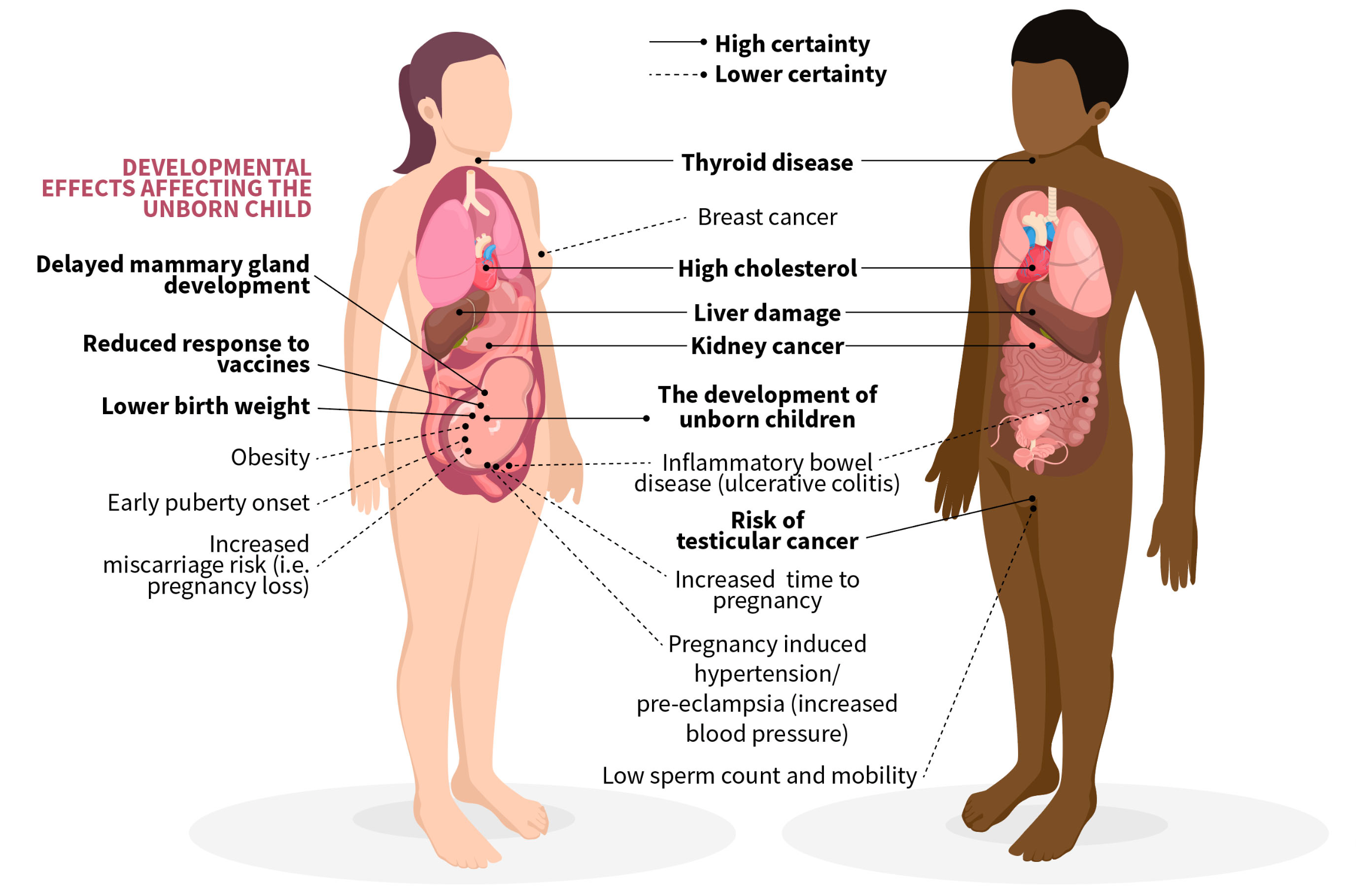
Common consumer products that PFAS may be used in include items such as: cosmetics, food wrappers, non-stick cooking utensils, waterproofing and cleaning chemicals, paints, sealants and even dental floss. Perfluoroocatanoic acid (PFOA) was used in Teflon coatings, and perfluorooctane sulfonate (PFOS) has been used in textile protectors, firefighting foams and semiconductor devices according to the OECD (2018). According to Gore et al. (2024) there is growing evidence that suggests PFAS are endocrine disrupting chemicals (EDCs) that may be linked to cancer development, impaired thyroid function and / or obesity[1]. As PFAS are extremely chemically stable they degrade at very low rates, are passed along food chains and are ubiquitous in the environment, which means that exposure is not limited to specific sites as may the case with other environmental contaminants.
4. How sophisticated is current knowledge of how and where PFAS enter the supply chain?
The EPA (2024) identifies several routes through which PFAS can be released into the environment, from a wide range of sources, including but not limited to:
A clear illustration of the pathways of PFAS in the environment is given by de Silva et al. (2021)[2]. Once in the environment they can be taken up by plants through the soil and water and subsequently pass along the food chain. There is evidence that along the food chain there is bioaccumulation and biomagnification as described by researchers such as Sun et al. (2022). Some PFAS are highly lipophilic and tend to accumulate in certain tissues of fish. Long-chain PFAS accumulate more than shorter-chain PFAS, due to stronger binding affinities.
People can be exposed to PFAS from ingesting contaminated water, fish from such waters or food grown on land that has PFAS contamination, as well as through direct dermal contact including from certain textiles. According to the European Environment Agency (EEA) one of the routes of PFAS into the environment is from textiles (EEA, 2024).
However, when asking the question “How sophisticated is current knowledge of how and where PFAS enter the supply chain?” the point is that although researchers, environmental activists and government policy makers may be aware of the iniquitousness of PFAS in the environment along with their resistance to decomposition and the harmful effects of some of these compounds on the human body – is the general public aware? Surely the question should be: “Does the average person in the street have ready access to full information regarding the risk of PFAS to them from sources around them?” In a very small pilot survey amongst qualified teachers at an international school the authors of this written evidence found that only one in five of the 25respondents had heard of PFAS, one in six had heard of POPs or EDCs and only 8% agreed with the statement that some “PFAS are POPs and EDCs”. When asked if they previously knew that these forever chemicals could cause a variety of diseases 50% of the respondents said they had no prior knowledge of these risks from PFAS. Bearing in mind that these respondents had all be educated to at least graduate level with the UK then this indicates that there could be good reason to investigate this further in the UK to increase the levels of awareness within the general public. Indeed, the Royal Society of Chemistry (RSC, 2025a) survey findings have comparable figures: 65% of respondents said PFAS were in food packaging, 63% said that non-stick pans contained PFAS and 21% in drinking water (whereas the Thai pilot study indicated 63%, 58% and 33% respectively). Furthermore, the RSC study revealed that two-thirds of the survey sample in the UK general public were not even aware of PFAS. Also significant in from the RSC survey is that nearly three-quarters thought chemicals and product manufacturers should be held accountable. 58% said this was the responsibility for the government although half that fraction said they had confidence in the government to achieve this.
5. What is the current understanding of how PFAS are made and then used in terms of product ranges, and geographical and socioeconomic distribution?
Brown et al. (2020) wrote that much of the awareness raising regarding PFAS in the Northeast of the USA less than a decade ago was down to just ten researchers at Northeastern University’s Social Science Environmental Health Research Institute. During the three years from 2016-2019 they had been striving to:
“make known the extent and health effects of PFAS contamination by publicly tracking new cases of discovery in real time and making this information accessible on an interactive map; aiding community groups and local and state governments in remediation, research, and regulatory action; engaging with journalists who publicize the problem; giving presentations at conferences and webinars of environmental activists and educators; organizing national conferences; and facilitating a national coalition of PFAS activist groups.” Brown et al. (2020) page 44.
Fortunately, in the UK, the Royal Society of Chemistry has been instrumental in leading this awareness campaign. For example, in a report the RSC (2023) states that:
“There is clear evidence to show that PFAS are widespread in UK surface and groundwaters, but the data also shows there are regional differences when PFAS have been quantified. Data from the Environment Agency (EA, 2021), and more recently from research by Stéphane Horel at the, presented in Le Monde (and other media outlets), indicate that there is widespread PFAS presence in water in the UK and Europe.”
The RSC with the Forever Pollution Project has also developed an interactive map of PFAS sites in the UK.[3] This will be a valuable tool for raising awareness amongst the general public.
Dinsmore (2020) reports that in their analysis of supermarket food packaging they:
“…identified packaging containing significant levels of PFAS in 8 of the 9 major UK supermarkets tested, and 100% of takeaways.” Dinsmore (2020) page 4.
Since the UK public generally consumes significantly high quantities of ultra-processed and fast food that frequently comes in such packaging then there is cause for concern. d’Angelo et al. (2020). There is also evidence to suggest that lower income households consume a higher proportion of fast foods in their diets, suggesting that they would be disproportionately impacted by PFAS from the food packaging sources.
Considering the socioeconomic impact should not be done in isolation from environmental impacts too. For example, George, Baker and Baker (2023) found that biomagnification and bioaccumulation in fish was below lethal levels in several species of fish in parts of the Great Lakes watershed. This means that further along the food chain there could more serious consequences at higher trophic levels. The point is that PFAS do not only affect humans, they impact on the health of other animals too. For example, Peritore et al. (2023) report that some researchers have found links between PFAS levels and hyperthyroidism in cats, as well as in chickens PFOA and PFOS were found to accumulate in kidney and liver, respectively. That does not mean that other species are convenient “canaries” for us. Since we collectively have been complicit in causing this environmental harm from manufacturing and consuming these synthetic compounds surely this places a moral responsibility upon us collectively to take action to reduce the harm done. Other sentient animals have played no role in causing this environmental pollution and harm to themselves, but humans have. So it should be humans who have to make reparations as far as possible.
Is the current regulatory regime for PFAS fit for purpose?
10. Is a precautionary approach to PFAS desirable or is an approach that uses regulation to assess their benefits and risks more appropriate?
The DWI (2025) regulations state that:
“The Inspectorate considers it reasonably practicable to achieve concentrations of individual PFAS in drinking water below 0.1 µg/L. A value of 0.1 µg/L corresponds to a daily intake of 0.0033 µg/kg body weight for a 60 kg adult drinking 2 litres per day and 0.01 µg/kg body weight for a 10 kg infant drinking 1 litre per day.”
The RSC (2025b) is calling for:
“…stricter limits on PFAS in drinking water in the UK. They are calling for a tenfold reduction of the current individual PFAS limit, from 100 nanograms per liter (ng/L) to 10 ng/L, and an overall combined limit of 100 ng/L for all PFAS. This aligns with stricter regulations being implemented in the US and EU.”
The precautionary approach is a wise starting point when it comes to environmental issues. Being unsure if a specific will cause harm – assume that it will. Alternatively, the expected value principle requires multiplying the probability of an anticipated harm by the likely degree of harm caused. In the case of PFAS pollution the problem is that there are thousands of unregulated specific PFAS chemicals and many of these have undetermined effects and unknown impacts on our health. Since there is little universal agreement on the risks from all PFAS then the precautionary approach may be a prudent first step. However, not all PFAS pose the same health risks, so it is possible to classify them according to their toxicological potential or modes of action to make regulation fairer and more efficient. Further research into the health effects of a wider number of PFAS is vital along with further improved monitoring. In addition, research for safer substitute chemicals and alternatives must also be supported. Contaminated sites should be managed and decontaminated although the costs for this will need to be estimated in advance and land may need to be classified to ensure that it is not used for growing agricultural crops. However, as Atkinson (2023) notes:
“The socioeconomic costs of PFAS contamination, including irreversible damage to natural resources, are considerable and difficult to quantify (one NGO even estimates the societal cost as high as €16 trillion per year).”
One further advantage of taking the precautionary approach is that the costs incurred by the impact of PFAS on health of current and future generations will only increase further if action is delayed, as clearly stated by Goldenman et al. (2019). They conclude that:
“A best estimate in the order of EUR 10–20 billion is certainly plausible. Significantly higher costs than that are likely if several cases similar to the contamination at Baden-Wurttemberg are identified, where costs of soil remediation have been estimated at up to EUR 3 billion.”
By not taking action now, the levels of PFAS will continue to rise and accumulate. Furthermore, the risks attached to some of these PFAS remains unknown so the future (health) costs could be even higher than expected. On top of which the future remediation costs could also be higher.
12. How do other jurisdictions around the world, including the EU and US, regulate PFAS use and disposal, and what lessons, if any, can the UK learn?
Thomas et al. (2023) identifies several different approaches to PFAS by various jurisdictions. The EU is largely regulated by Registration, Evaluation, Authorisation and Restriction of Chemicals (REACH) as Substances of Very High Concern. They formerly came under the POPs regulations. Certain compounds such as PFOS and PFOA have stricter regulations as more is known regarding their toxicity and persistence in the environment. The limits for drinking water in the EU are comparable to those now set in the UK; specifically a 'new group limit' value for 'PFAS Total' of 0.5 μg/L or the limit for the 'Sum of PFAS' of 0.1 μg/L.
In the USA the Food and Drug Administration banned the use of long chain PFAS in materials that come into contact with food. These long chain PFAS are more resistant to chemical decomposition than shorter chain PFAS. Therefore, they potentially have a longer lasting impact on living organisms and can persist further along the food chain.
In Australia the risks of 200 PFAS have been assessed for use in the country. They have focused on PFOA and PFOS, the precursors sued to make them as well as shorter chain replacements. New Zealand plans to ban all fire fighting foams that contain PFAS by the end of this year and a number of Asian countries including China, Japan, and South Korea are planning to manage PFAS in accordance with the Stockholm Convention on POPs. There is light on the horizon and the UK can play a role in setting standards for this environmental cleanup. By addressing this now the government has the opportunity to build public trust.
May 2025
References:
Atkinson, B. (2023) Addressing the growing threat of PFAS (or 'forever chemicals') in the UK [Accessed online 26-5-25. Available from: https://www.adlerandallan.co.uk/knowledge/insight/growing-threat-pfas-forever-chemicals-uk].
Brusseau, M.L., Anderson, R.H., and Guo, B. (2020) “PFAS concentrations in soils: Background levels versus contaminated sites” Science of The Total Environment 740: 140017 [Accessed online 20-5-25. Available from: https://doi.org/10.1016/j.scitotenv.2020.140017].
Brown, P., De La Rosa, V., and Cordner, A. (2020) “Toxic trespass: Science, activism, and policy concerning chemicals in our bodies” Ch.1 in Davies, T. and Mah, A. (Eds.) Toxic truths: Environmental justice and citizen science in a post-truth age Manchester University Press, Manchester, pp 34-58.
d’Angelo, C., Gloinson, E.R., Draper, A. and Guthrie, S. (2020) Food consumption in the UK Trends, attitudes and drivers RAND Corporation, Santa Monica, Calif., and Cambridge, UK [Accessed online 25-5-25. Available from: https://www.rand.org/content/dam/rand/pubs/research_reports/RR4300/RR4379/RAND_RR4379.pdf].
De Silva, A.O., Armitage, J.M., Bruton, T.A., Dassuncao, C., Heiger-Bernays, W., Hu, X.C., Kärrman, A., Kelly, B., Ng, C., Robuck, A., Sun, M., Webster, T.F., and Sunderland, E.M. (2021) “PFAS Exposure Pathways for Humans and Wildlife: A Synthesis of Current Knowledge and Key Gaps in Understanding” Environ Toxicol Chem. 40(3):631-657 [Accessed online 26-5-25. Available from: https://pubmed.ncbi.nlm.nih.gov/33201517/].
Dinsmore, K.J. (2020) Forever chemicals in the food aisle: PFAS content of UK supermarket and takeaway food packaging [Accessed online 26-5-25. Available from: https://www.researchgate.net/publication/339230341].
DWI (2025) Drinking Water Inspectorate Guidance to water companies: Guidance on the Water Supply (Water Quality) Regulations 2016 (as amended) for England and Water Supply (Water Quality) Regulations 2018 for Wales specific to PFAS (per- and polyfluoroalkyl substances) in drinking water [Accessed online 20-5-25. Available from: https://dwi-production-files.s3.eu-west-2.amazonaws.com/wp-content/uploads/2025/03/24141825/DWI_PFAS-Guidance_Mar_2025.pdf].
EEA (2024) PFAS in textiles in Europe’s circular economy [Accessed online 24-5-25. Available from: https://www.eea.europa.eu/en/analysis/publications/pfas-in-textiles-in-europes-circular-economy].
EPA (2021) PFAS Strategic Roadmap: EPA’s Commitments to Action 2021–2024 [Accessed online 20-5-25. Available from: https://www.epa.gov/system/files/documents/2021-10/pfas-roadmap_final-508.pdf].
EPA (2024) Our Current Understanding of the Human Health and Environmental Risks of PFAS [Accessed online 24-5-25. Available from: https://www.epa.gov/pfas/our-current-understanding-human-health-and-environmental-risks-pfas].
George, S.E., Baker, T.R., and Baker, B.B. (2023) “Nonlethal detection of PFAS bioaccumulation and biomagnification within fishes in an urban- and wastewater-dominant Great Lakes watershed” Environmental Pollution 321: 121123 [Accessed online 14-4-25. Available from: https://pubmed.ncbi.nlm.nih.gov/36681373/].
Goldenman, G., Fernandes, M., Holland, M., Tugran, T., Nordin, A., Schoumacher, C. and McNeill, A. (2019) The cost of inaction A socioeconomic analysis of environmental and health impacts linked to exposure to PFAS Nordic Council of Ministers [Accessed online 26-5-25. Available from: https://norden.diva-portal.org/smash/get/diva2:1295959/FULLTEXT01.pdf].
OECD (2018) Summary report on the new comprehensive global database of Per- and Polyfluoroalkyl Substances (PFASs) OECD Series on Risk Management of Chemicals, OECD Publishing, Paris [Accessed online 20-5-25. Available from: https://doi.org/10.1787/1a14ad6c-en].
Peritore, A.F., Gugliandolo, E., Cuzzocrea, S., Crupi, R., and Britti, D. (2023) “Current Review of Increasing Animal Health Threat of Per- and Polyfluoroalkyl Substances (PFAS): Harms, Limitations, and Alternatives to Manage Their Toxicity” Int J Mol Sci. 24(14): 11707 [Accessed online 26-5-25. Available from: https://www.mdpi.com/1422-0067/24/14/11707].
RSC (2023) Evidence report PFAS in UK waters – presence, detection, and remediation [Accessed online 25-5-25. Available from: https://www.rsc.org/globalassets/04-campaigning-outreach/policy/environment-health-safety-policy/pfas-evidence-report.pdf].
RSC (2025a) Public perceptions of PFAS: What the UK thinks of forever chemicals [Accessed online 25-5-25. Available from: https://www.rsc.org/globalassets/07-news-events/rsc-news/news-articles/2025/01-january/pfas-public-attitudes/pfas-public-attitudes-summary-report.pdf].
RSC (2025b) RSC challenges UK Government to reduce PFAS levels in British water as research highlights serious health risks posed by ‘forever chemicals’ [Accessed online 25-5-25. Available from: https://www.rsc.org/news-events/articles/2023/oct/pfas-cleaning-up-uk-drinking-water/#:~:text].
Sun, J.M., Kelly, B.C., Gobasm, F.A.P.C., and Sunderland, E.M. (2022) “A food web bioaccumulation model for the accumulation of per- and polyfluoroalkyl substances (PFAS) in fish: how important is renal elimination?” Environ Sci Process Impacts 24(8): 1152-1164 [Accessed online 15-4-25. Available from: https://pubs.rsc.org/en/content/articlelanding/2022/em/d2em00047d].
Thomas, T., Malek, A., Arokianathar, J., Haddad, E. and Matthew, J. (2023) “Global Regulations Around PFAS: The Past, the Present and the Future” ICRL 2023(1): 3-17 [Accessed online 25-5-25. Available from: https://icrl.lexxion.eu/data/article/18898/pdf/icrl_2023_01-005.pdf].
UNEP (2017) Towards a Pollution-Free Planet Background Report. United Nations Environment Programme, Nairobi, Kenya. [Accessed online 14-4-25. Available from: https://wedocs.unep.org/bitstream/handle/20.500.11822/21800/UNEA_towardspollution_long%20version_Web.pdf?sequence=1&isAllowed=y].
[1] A clear illustration of the possible effects of PFAS on the human body and developing foetus is provided by the Royal Society of Chemistry and is available online from: https://epi-rsc.rsc-cdn.org/globalassets/22-new-perspectives/health/pfas/effects-of-pfas-on-human-health.png?version=bcf2476a
[2] A diagrammatic visualization of PFAS pathways in the environment is available online from: https://pmc.ncbi.nlm.nih.gov/articles/PMC7906948/figure/F1/
[3] An interactive map of PFAS pollution sites in the UK is available from: https://www.rsc.org/policy-evidence-campaigns/environmental-sustainability/sustainability-reports-surveys-and-campaigns/cleaning-up-uk-drinking-water/