Written evidence submitted by medConfidential (DCH0035)
- Like a dog that bites its own tail without any understanding of cause and effect, Government believes it is digitally omnipotent without consequence – epitomised by HMG’s recent legal notice to Apple that no UK customer of Apple can be permitted to backup their device if Apple themselves can’t access that data. That is the political culture of the new digital centre of government and the NDL.
How should the digital centre be delivered in a way that ensures equitable access to public services?
- The digital centre, and digital services more widely, must have meaningful and effective civil society and expert engagement and involvement. For the last decade, the “Privacy and Consumer Advisory Group” (later the “One Login Inclusion and Privacy Advisory Group”) played that role for government identity and personal data projects. The new digital centre chose to abolish it. Civil servants will focus on their public task, pay attention only to their narrow objectives, and there needs to be some group taking a bigger perspective than a narrow Ministerial briefing,[1] to avoid process grinding on chewing through citizens until the press outcry is loud enough – Horizon took 2 decades, Carers Allowance took only one. How many more will be created by DSIT’s refusal to listen?
- The worst ”improvements”/changes/degradations to online services are always made for someone’s reasons. They are always justified by the people who sign them off given their incentives. For consumers of tech services this results in “enshittification”, but public services offer the perspective of how that looks from the service provider side. No one is evil (usually), they just can’t be bothered (or the people who would like to simply aren’t permitted) to do all the work to deliver the service properly. This is how the carers allowance went wrong. The developers of a new system decided things beyond their ability to change were not worth changing to match. The GovUK app will become a monster factory, and users of those services will be punished the way DWP’s Carers Allowance failures treated pensioners…
DSIT is delivering An “Unaccountability Machine”
- Journalist Dan Davies describes the “Unaccountability Machine”[2] appearing across the modern state where process grinds on while individuals assuming someone somewhere would always act responsibly in future, while the machine grinds on. A human example is the Carers Allowance fiasco where DWP had been told someone was not eligible for a payment in a period, DWP knew they were not eligible in that period, and because the system was incompletely “digitally transformed”,[3] DWP paid them anyway and then ruined their lives accusing them of fraud and wanting to impound their life savings, simply following DWP’s process. In the most visceral equivalent described, 400 live squirrels were tossed into an industrial shredder[4] by people unaccountably following an official process.
- Civil society involvement is not enough to prevent a department acting in its own interests at the expense of citizens. There is an online service[5] to allow you to express your NHS National Data Opt Out, which largely stops your medical records being used for purposes other than your care[6]. If you were to try and express that wish for your primary school aged child, living at home, with no complexities whatsoever, there is no online service available. Instead, (in addition to the online service for you) you have to fill in a form for your kids and send it off to a “contact centre”. The policy intent of making life difficult for parents to make a decision for their children outweighs all other priorities.
- Government uses digital tools to impose policy, and punishes people with paperwork simply because they can.[7] Indeed, it is the public task for some civil servants to come up with ever more ways to do so.
- When a company has a reform or digital service fails, the company suffers, maybe the CEO gets fired, but no “customer” is threatened with jail for fraud, or is suddenly unable to buy food. Digital services by Government are fundamentally different and the harder edges of the State were largely ignored until, at best, relatively recently. While the path Departments wish to encourage may be digitised and simple, actions they wish to discourage are the equivalent of the dark shadowy alleys you wouldn’t want to walk down alone at night. These are deliberate decisions. For example, HMRC should be asked to describe how this incoherency happens – lots of little sections of HMRC all delivering their public task, and the public loses as a result.
- The committee will likely seek evidence from those who have had experience of working in and around the Government Digital Service since it was formed after the 2010 election. We would encourage you to ask those witnesses what lessons they have taken from the Carers Allowance mess (if they were involved in services that created it, or even if they weren’t). Examining processes like is one thing PCAG did to the limited extent that the Government Digital Service allowed.[8]
Devices, Apps, Sensors, Notifications
- In late 2024, theme 3 of the Independent Sentencing Review was entirely about using devices and sensors to monitor people in the community instead of prison. The difference between being returned to prison or maintaining some degree of freedom will mean the incentives to game the system are extreme.
- It is reasonable for a pregnant woman using a smartwatch to want to share those readings with her doctors, or indeed anyone else wishing to do so. It is the position of the Department of Health and NHS England that any data made available in that way should be made available via the NHS app, where it must be copied into Palantir for any other doctor to see about hat patient in future, and for that data to be sold by NHS England to anyone who wishes to buy it. The only choice patients will have is not to provide the (potentially life saving) data in the first place – the digital offer really is your data or your life.
- Or, as the Prime Minister put it from a Government perspective: “We know many of you feel shackled by bureaucracy, frustrated by inefficiency and unable to harness new technology”… “We are determined to empower you – not through words, but action – to maximise the collective power of the state."[9]
- It is the belief of Departments (and specifically the belief of DHSC, of DWP, and also of private insurers[10]) that taking copies of health data from sensors on your personal phone is a legitimate, approaching mandatory, act if you wish access to services they provide. The privacy issues here are obvious, and will get picked up by others.
- Such data can be written by apps that source data from external sensors, or from data generators. The data is not reliable for decision making when those decisions can go against the interests of the citizen, and people are compelled to engage because compulsion is in the interests of the state. Any good metric that becomes a target ceases to be a good metric.
- The Secretary of State for Health says “Our widening waistbands are also placing significant burden on our health service”,[11] and “Health Secretary to hand obese patients drug to prevent them ‘holding back our economy’”[12] to justify interventions on obesity and disability. One of those proposed[13] interventions is to give those people smartwatches which measure step counts.[14] Inevitably, DWP will be expected to mandate a step count per day of face sanction, inevitably such a target would get gamed – people would put the sensor on their dog, or simply use technical means to write fake historical data. What sensors an individual wears and records on their own personal device is a matter for them, but HMG culture and policy (and political culture and one upmanship on benefits) means them storing their own data on their own device for their own reasons could be seen by DWP as welfare fraud merely because DWP later insists on taking a copy of that data via the gov.uk app in order to make decisions.
- As the Cabinet Office’s “Fraud Profession” follows reasoning akin to Homer Simpson,[15] would DWP consider someone writing data to their own device to be an act of fraud against DWP?
What assessment can be made of DSIT’s work on establishing the digital centre to date?
- We would offer evidence on how it is going, but that would require there to be some evidence that it is going at all. DSIT have not engaged with medConfidential.[16] We expect that many data projects discussed below will be given a “National Data Library” branding when the NDL begins being functional, or begins some branding.
- In general terms, DSIT’s decisions suggest a focus on “Government needs not user needs”, centralising data so the government of the day can do whatever it wishes to citizens, in the belief that the current government is forever. Some of their activities are indistinguishable from the new US administration’s “DOGE” culture.
- The Department of Health is pushing a single central care record, continuing everything held about a patient anywhere in the NHS, which will all be readable wherever the NHS logo is seen – your GP notes accessible across the country in ase you happen to walk into a Pharmacy in Truro or Bewick-Upon-Tweed. As far as DH’s public statements currently state, patients (your constituents) will have no choice whether they have one of these records, they will not be permitted to know when or where the record has been accessed and every note a GP has ever written about you was read (or when they received care and it wasn’t). This is the current assessment of the direction of travel of digital services in health.
- The Department of England and DSIT have been doing “business models for data” work which expects to sell as much health data as it can to add funds to this year’s balance sheet, despite those costs being recouped from the NHS in the form of future fees for the products built with them (plus overheads etc).[17] In focusing on revenue, most proposals eat ever more of the NHS budget. All business models get gamed for private benefit at public expense. The only sustainable approach is to minimise the cost to the public purse – what in the context of prescription drugs is generic pricing.
- The culture driving priorities for the NHS App is equally dysfunctional.
Data sharing
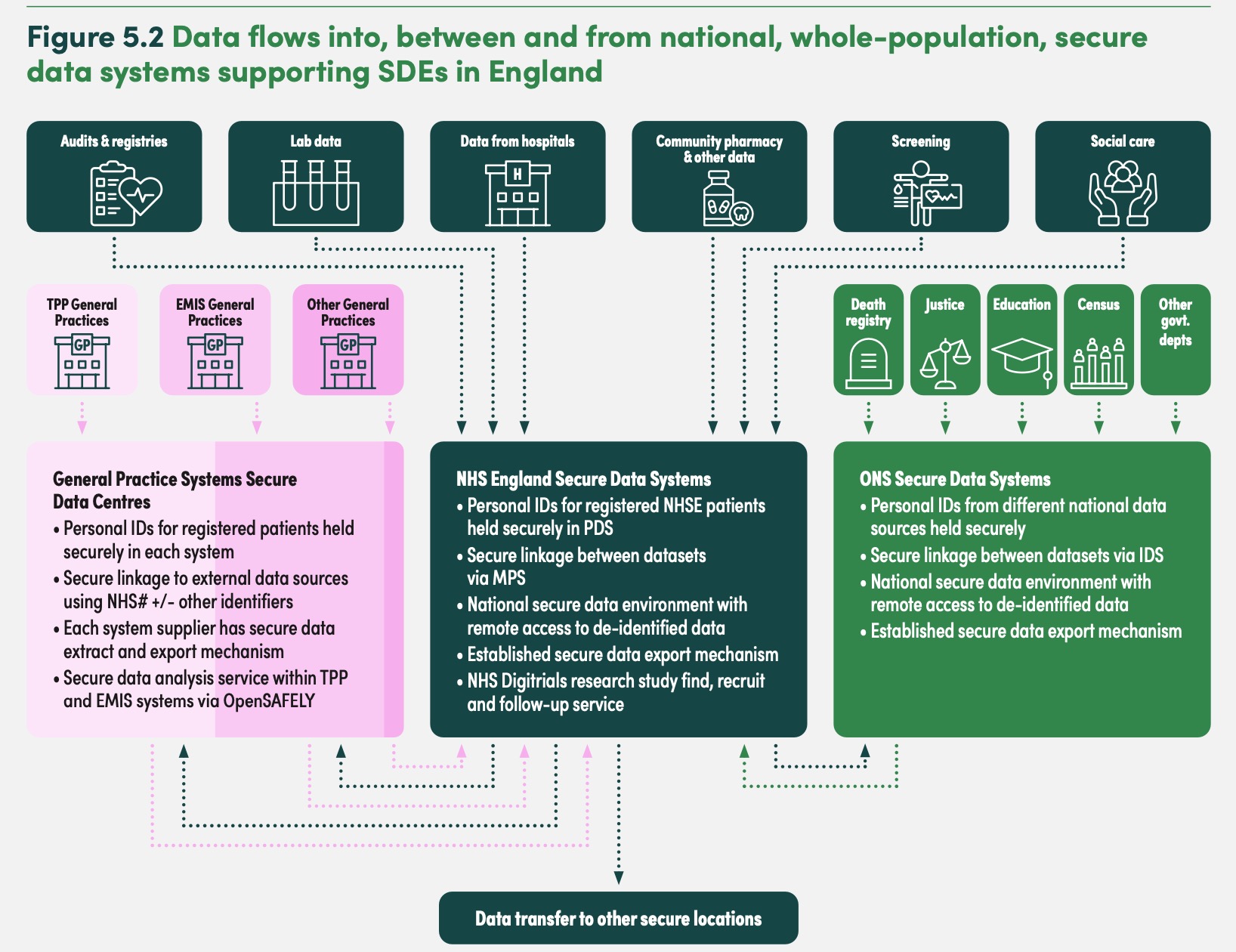
- The Office of National Statistics has built the everyone database, to link your tax and NHS records to census records, other surveys (and wanting to link justice, education, data – over time it will everything that has ever happened in your life, and any crimes you may have fallen victim to). The database was built using ONS’s existing authorities, and is not subject to any external scrutiny. We do however welcome their recent publication of the title and organisation of projects using some data. It is a start, even if what data the project is using is currently withheld. One of the NHS regional SDEs (which doesn’t stand for Some Data Escapes, but that happens too), can’t publish some details because they told their commercial partners they wouldn’t. Other SDE environments use a platform built with public funds designed to allow commercial customers to run code on public data in a way that only the commercial customer knows what was run.
- Government has decided to link data across Government for policy purposes, and it believes it can do whatever it wants with it. The first thing it did was worked out whether you can measure the economic benefit from NHS treatments, and finding out that you could,[18] started down the path of doing all treatments. NHS England will then use that to prioritise operating theatres and NHS resources accordingly (using the Federated Data Platform from Palantir), implementing a policy view that if you suffer from a disease of the rich you should do well, if you suffer from a disease of the poor then that’s unfortunate for you. This should have greater public debate, but like all digital decisions, and as the new US administration is finding, public bodies can quietly make changes to digital systems to implement policy priorities and it’s very difficult for anyone outside to understand what was done.
- One of the hopes of some for the NDL is that decision making is be moved far away from the organisations who are responsible for the data; moved from those who will be responsible for the consequences of catastrophes instead be given to those who can focus on saying yes to requests no matter the harms. The NHS has tried this from time to time, and it has gone badly. Most recently UK Biobank watered down their access restrictions in the name of “more is more” policy on data use, and handed data to dodgy shell companies, to eugenicists operating out of the same office as Q-Anon front companies, and “hostile states”. They claim it’s all fine.
- In multiple different decisions, including the Apple decision with which we opened, the data sharing plans of the digital centre, and the central care record plans of the Department of Health, that if data is available to anyone in authority somewhere, then it must be available to everyone in authority. Data that could be collected must be collected and shared to anyone Government wishes, if you want any benefit to you personally. Clubcard culture[19] has permeated the new government – data mining everything without constraint in pursuit of a public task.
- As happened to A-Level students in 2020, given the continuing culture and practices of the digital centre of government, the “digital centre’s” algorithmic assessments will shred the lives of your entirely innocent constituents as the next incarnation of the “squirrels of Schipol”.[20]
12 March 2025
About medConfidential
medConfidential is an independent non-partisan organisation campaigning for confidentiality and consent in health and social care, which seeks to ensure that every flow of data into, across and out of the NHS and care system is consensual, safe, and transparent.
Founded in January 2013, medConfidential works with patients and medics, service users and care professionals; draws advice from a network of experts in the fields of health informatics, computer security, law/ethics and privacy; and believes there need be no conflict between good research, good ethics and good medical care.
We also engage with data use across Government, as to a first approximation, the data that institutions of state want to copy most is your medical record.
[1] Especially where those briefings are assisted by AIs trained on official truth rather than reality.
[2] Why Big Systems Make Terrible Decisions and How The World Lost Its Mind www.amazon.co.uk/Unaccountability-Machine-Systems-Terrible-Decisions-ebook/dp/B0CGFWBFD6
[3] It appears the independent inquiry hasn’t yet opened a call for evidence let alone reported what actually happened inside DWP after the carers allowance system digitisation in the 2010s.
[4] https://www.independent.co.uk/news/airline-killed-440-squirrels-in-giant-shredder-1087522.html
[5] If you want to look at it, there are multiple steps and a clear confirmation of intent before anything changes.
[6] There are many loopholes meaning it is ignored 67% of the time, but it exists.
[7] We cover this more widely in our “Baby then Bureaucracy” annex about Universal Credit.
[8] One example was GDS saying they were open to receiving comments on documents that they repeatedly refused to share and diligently refused to accept there was any possible incoherency. The civil servant was then promoted, and he would have fed squirrels into a shredder with equal diligence.
[9] https://www.civilserviceworld.com/professions/article/civil-service-reform-performance-exits-agile- productive-starmer-wormald
[10] Smartwatches measuring mortality are the new tool for insurers – Bloomberg https://www.bloomberg.com/news/articles/2025-02-25/smartwatches-measuring-mortality-risks-are-new-tool-for-insurers
[11] https://www.telegraph.co.uk/politics/2024/10/14/widening-waistbands-are-a-burden-on-britain/
[12] https://www.telegraph.co.uk/news/2024/10/14/weight-loss-jabs-get-britain-working-wes-streeting/
https://www.gov.uk/government/news/landmark-collaboration-with-largest-pharmaceutical-company
[13] https://institute.global/insights/public-services/watch-ticking-five-year-plan-harness-wearable-health -tech says “there is the potential for loss-framed rewards to create financial burdens for participants if those who fail to meet their activity targets are then required to make larger monthly payments. This risk can be mitigated by spreading the cost over a longer period, and by giving participants who qualify for means-tested benefits, such as Universal Credit, a larger subsidy – either entirely conditional or with an unconditional component.”
[14] https://www.telegraph.co.uk/news/2024/10/19/health-monitoring-smart-watches-nhs-wes-streeting- labour/
[15] As described on the front cover of our look at Fraud and Error in DWP https://medconfidential.org/wp-content/uploads/2020/09/Annex3-error-and-fraud-20200908.pdf
[16] Apparently you’re supposed to email them. We have. We’ve heard nothing specific, but we are apparently one of their “stakeholders” to whom they send the “DSIT Download”.
[17] https://medconfidential.org/2025/business-models-for-data-2025-what-hasnt-worked-what-has- and-what-to-do-next/
[18] https://www.ons.gov.uk/peoplepopulationandcommunity/healthandsocialcare/healthandwellbeing/articles/theimpactofbariatricsurgeryonmonthlyemployeepayandemployeestatusengland/april2014todecember2022
[19] Clubcard culture came into government via the Centre for Data Ethics and Innovation (as was), whose first chair was also Chair of OfQual during the 2020 A-level algorithms debacle, and whose second chair was cofounder of clubcard), and was renamed the Responsible Technology Adoption Unit which missed the point that irresponsible adoption is the problem, prior to being swallowed by DSIT into GDS. https://x.com/medConfidential/status/1357037423172141061
[20] Who’s responsible for our accountability problem? https://www.ft.com/content/2e1042d5-5e89-4fb6-bbee-de605a534172